Symmetry Breaking by Surface Steps
The problem with creating one-dimensional (1D) systems based on surface reconstructions is the typical existence (due to surface symmetry) of a few equivalent directions on the surface along which the reconstructions can form. On the figure below an example is shown of a surface with 3 such equivalent directions; 1 desirable one (marked by green lines) and 2 undesirable ones (marked by red lines). Surface reconstruction can be oriented along each of the equivalent directions on such a surface, resulting in a multi-domain reconstruction.
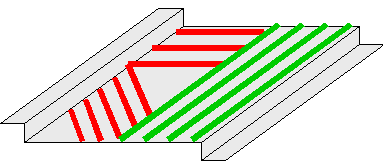
Surface steps can be helpful in such situations because their presence enhances the formation of reconstruction rows (or atomic chains) in the direction along the steps and inhibits domains growing along the other two directions. Steps on a well prepared stepped surface run essentially along the same direction, making that direction a preferential one for formation of any structures. Such a uniform step array, therefore, induces the formation of a single-domain surface reconstruction over macroscopic areas, which are suitable for analysis using STM and PES.
Two examples of single-domain surface reconstructions are Ca-Si(111)3×1 and Au-Si(111)5×2 on vicinal Si(111).
Return to the discussion of low-dimensional structures.
