Peierls Distortion
Uniform one-dimensional (1D) atomic chains and similar systems are generally unstable against Peierls distortion, which can be illustrated by the following diagram.
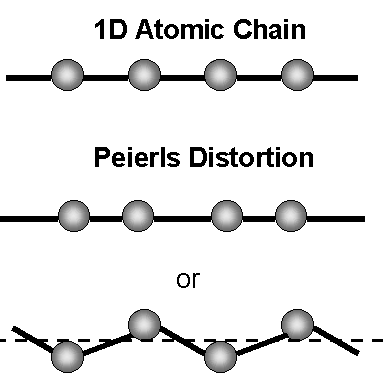
A uniform 1D chain typically can lower its energy by doubling its period. Most often it happens in one of the two ways depicted in the above diagram. Either the neighboring atoms alternately get slightly closer and further apart, or they can get buckled (symmetrically or asymmetrically), both distortions resulting in a chain of dimers. On a surface, buckling can happen both in and out of the surface plane.
The resulting chain with the doubled period is strictly speaking no longer one-dimensional, since all atoms are not identical (there are two distinctly different types after dimerization). In practice it often leads to systems undergoing a metal-to-insulator transition, as an odd electron count for a metallic 1D chain changes into an even count for an insulating chain of dimers.
Return to the discussion of low-dimensional structures.
