2D Growth Modes on Stepped Surfaces
CaF2 Growth Modes on Stepped Si(111)
A convenient model system for studying heteroepitaxial growth on vicinal surfaces is CaF2 (Calcium Fluoride) growth on stepped Si(111). This material combination exhibits several properties important for a good model system.
- Atomically straight steps on Si(111) minimize influence of defects on the growth.
- Lattice mismatch is only 0.6% at room temperature.
- Atomically-sharp interface between the two materials (no alloying).
- Materials distinguishable in STM images with chemical contrast.
- Calcium Fluoride has potential as a mask material for selective deposition/etching.
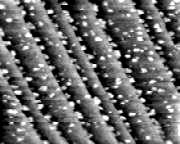
Random Islands
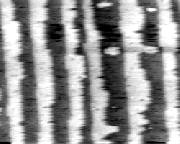
Step Flow
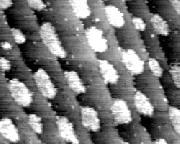
Array of Dots
Transition from Dots to Stripes
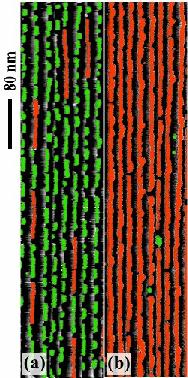
Apart from the possible technological importance for making arrays of quantum wires and quantum dots, the step flow and dots-at-steps modes are of interest for fundamental understanding of the 2D growth mechanisms.
A particularly interesting effect is the existence of the critical coverage, which determines the transition from growth of dots and broken stripes to continuous stripes. Image on the left shows the broken stripe growth below the critical coverage (a) and almost continuous stripes close to critical coverage (b). Note that in case (a) almost all stripes are shorter than 80 nm (colored green), whereas in case (b) almost all stripes are longer then 80 nm (colored red).
This switch from a non-wetting growth mode (dots and short stripes) to fully wetting mode (long stripes) is a uniquely two-dimensional growth mode, which has no analog in conventional 3D epitaxy. The new growth mode is produced because stripes growing on upper and lower terraces interact with each other and with the surface steps.
